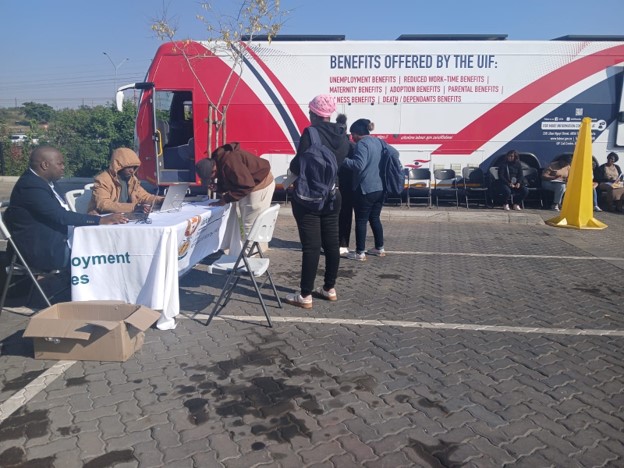
As unemployment continues to pressure many households in Soshanguve, residents are encouraged to verify their Unemployment Insurance Fund (UIF) registration status before losing their jobs to avoid delays in accessing benefits.
The UIF has urged workers to understand their labour rights, confirm their registration status with employers, and make use of online application systems to prevent delays or the possible forfeiture of benefits when applying for financial relief after retrenchment or job loss.
According to the Department of Employment and Labour, the Tshwane UIF office assists an average of 10 000 clients per month, excluding payment-related services, as growing numbers of unemployed residents seek financial support through the fund.
Despite the high demand, the office continues to face operational challenges affecting both workers and officials. These include system failures, water interruptions and employer non-compliance, which the department says are among the biggest obstacles to processing UIF applications efficiently.
Department of Employment and Labour communications officer Ms Sekhothali Lekalakala said many workers only discover problems with their UIF contributions after losing their jobs.
“One of the major concerns is that some employers fail to register workers for UIF contributions despite deducting money from their salaries,” said Ms Lekalakala.
She urged employees to regularly confirm that UIF contributions are correctly deducted and submitted on their behalf.
Some residents say service delays at local labour offices have left them frustrated. Soshanguve resident, Mr Moses Monama, claimed that the slow processing of UIF-related matters is affecting many unemployed people seeking assistance.
“People are suffering right before our eyes. I think the Soshanguve Department of Labour is trying to put people’s spirits down so that they use other labour offices,” said Mr Monama.
He added that long waiting periods and ongoing delays continue to frustrate residents who rely on UIF support during difficult financial times.
The department has acknowledged operational challenges, including system failures and water interruptions, which officials say continue to affect service delivery.
Officials also expressed concern over the growing number of late applications. Some individuals only attempt to apply after the prescribed period has expired, which may result in the forfeiture of benefits.
Workers have up to 12 months after losing their employment to apply for UIF benefits, while death benefit claims must be submitted within 18 months.
The department further clarified that not everyone qualifies to claim UIF benefits. Applicants must have contributed to the fund and may only apply under qualifying circumstances such as dismissal, retrenchment, contract termination or employer bankruptcy.
Individuals who voluntarily resign, are already receiving certain other benefits, or were suspended for fraud, do not qualify for UIF claims.
In communities such as Soshanguve, where many residents depend on temporary, contract-based and seasonal employment, UIF support remains an important source of relief for households facing economic hardship.
Residents have also raised concerns about long queues, delays in processing applications and a lack of awareness regarding UIF requirements and deadlines.
The department has encouraged workers to regularly check their payslips to ensure that UIF deductions are being made and that employers are properly submitting them, to avoid complications when applying for benefits.
Meanwhile, Minister of Employment and Labour Nomakhosazana Meth has moved to address what the department described as misinformation surrounding the UIF Online claims platform. In a media statement issued on 25 May 2026, Meth said the UIF Online platform was introduced to streamline and accelerate the claims process by enabling direct client submissions, real-time claim tracking, and automated communication throughout the application process.
According to the minister, the digital platform has already delivered positive results, with more than 4.5 million claims successfully processed and paid out by April 2026. This, she said, reflects improved access to UIF services and the growing adoption of digital systems by workers.
Meth further assured beneficiaries that no applications were lost following the closure of the previous uFiling employee claims portal. She stated that all submitted applications were securely stored and migrated to the new system.
The department added that awareness campaigns, enhanced call centre support, and nationwide stakeholder engagements were implemented to assist workers in transitioning to the new online platform and to improve access to UIF services. In communities such as Soshanguve, where many residents rely on temporary, contract-based, and seasonal employment, UIF support remains a critical source of relief for households facing unemployment and economic hardship. However, residents have raised concerns about long queues, processing delays, and limited awareness of UIF requirements and application deadlines.
The department has urged workers to regularly check their payslips to ensure that UIF contributions are correctly deducted and submitted by employers, in order to prevent complications when applying for benefits.